1920’s Stella Guitar
In 1992 I was asked to help a friend move his stuff out of a storage unit. While we were doing it I noticed a beaten up old guitar case. When I asked about it I was told “It’s an old shitter, chuck it in the skip bin” He saw the look of surprise on my face and said “ You like old crap you can have it if you want” I opened the case up and immediately stashed it in the car. To make sure I asked again “Are you sure you don’t want it?” He didn’t want it, it was mine. You beauty! When I asked about it later I found out it was in an old house in Como pde Como that was a deceased estate that was bulldozed when he moved out. I couldn’t get home fast enough to check it out.
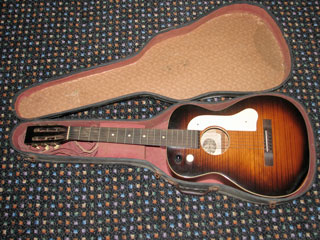
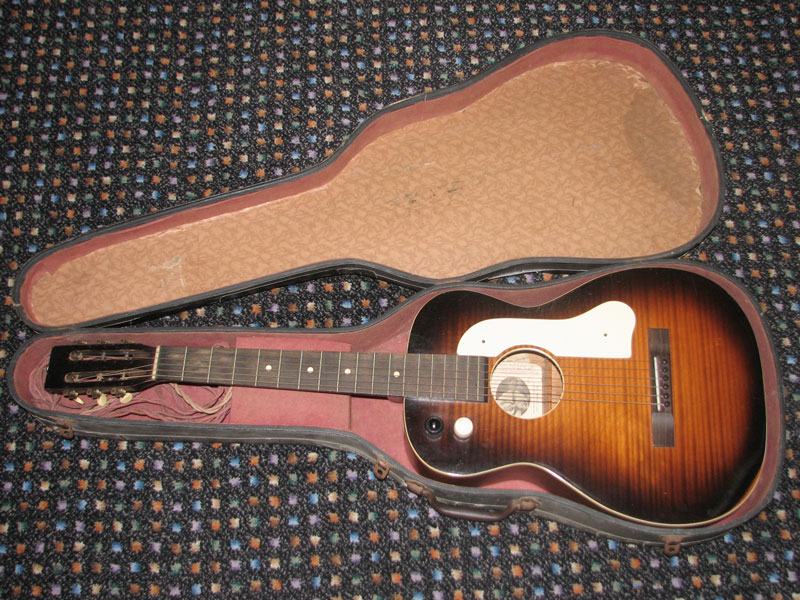
It is a ¾ size 6 string with a deep V neck and besides having a cracked bridge looked playable. Judging by the amount of wear on the fret board it has been played a lot. It has 2 knobs on the face above where the neck joins the body one black and one white (presumably volume & tone). There is a hole cut on the side of the guitar above the neck. Inside the guitar was a Bakelite light fitting that fitted the hole it was joined to the 2 knobs by electrical wire which ran back to a pickup attached to the bridge. The pickup is a horseshoe magnet with a wound coil in the mouth of the U and mounted below the bridge by 2 screws. In the case was a loop of electrical wire that has an electrical fitting on one end and 2 sprung clips on the other end. It looks like a torture instrument but it’s probably the lead.
Inside the sound hole there is an ad glued down to the inside. There is a photo of a smiling man playing a Banjolin (Mandolin neck with a small banjo type body)
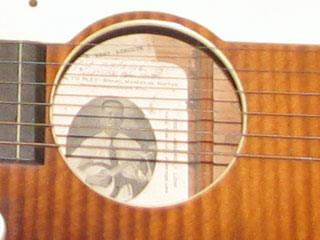 Across the top of the ad is written in beautiful old script: Amplified 24/8/46 by Fred WH Hallett
Below that the printed ad reads: Learn to play – Banjo, Mandolin, Guitar, Piano, Accordeon etc. (The spelling is as printed)
On either side of the photo running vertically it reads:
Left side- “The fun of music is in the making of it”
Right side- Fees- absurdly low call for full particulars
Below the photo – Fred WH Hallett – Principal
Then in bolder print- The Hallett music Academy
359 Marrickville rd Marrickville
Hours: Weekdays 2 till 7 (or by appointment)
Musicians supplied for all functions
The owner must have been a professional musician. Nobody else would have needed this conversion done in ’46.
I took the guitar to Gerard Gillet a luthier at Botany to have the bridge fixed and hopefully get some answers. As he opened the case he said “Ah, it’s a Stella, mid 20’s probably” He went on to say that they were a cheapie at the time bought normally by mail order. But the pickup conversion was very interesting; it should be in the Powerhouse museum. He put a new bridge on it and it plays well but due to the depth of the neck is hard work compared to the guitars of today for standard play. So I had some answers but more questions. Unfortunately researching the old girl has been put off till recently due to other commitments but now I have the time I’m trying to piece together its history. I have some answers but many more questions. Hopefully some one can help. I know from my parents & others that the post WW2 era in Sydney was buzzing musically. More than once I’ve heard that you could go to a dance on any night of the week. With what I’ve found I am hoping to jog someone’s’ memory & the true story of this instrument and the people involved can be pieced together.
Here’s what I’ve found so far: The guitar was in a house in the northern end of Como parade Como NSW in the late 80’s- early 90’s owned by a man possibly named Marsh.
He was friends with the Freeland family that lived in Central rd Como. John Freeland was a music teacher & played in the SSO as well as other professional music work.
His son Paul Freeland was the original drummer in Moving Pictures.
The conversion was done in Marrickville in august 1946 by Fred Hallett. The only references to Fred Hallett so far are a couple of newspaper ads from the 30’s for events with “The Hallett string ensemble” playing.
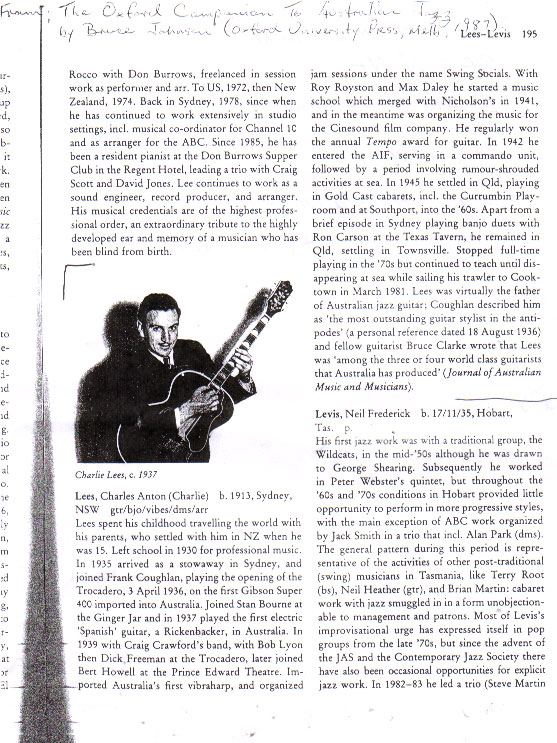
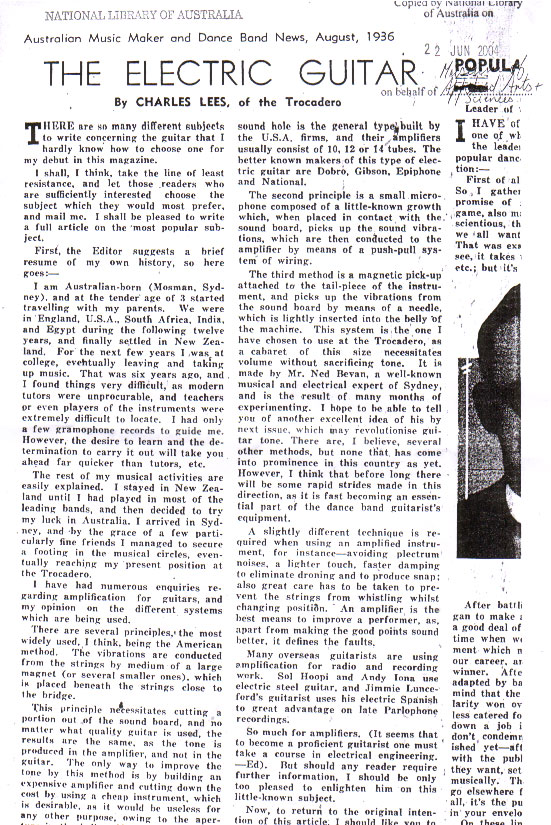
Noted guitarist Charles Lees was using a magnetic pickup in the 30’s made by Ned Bevan in Sydney. In his august 1936 article in Australian music maker & dance band news Charlie said that Ned was working on an idea that would revolutionise guitar tone. This guitar seemingly has a tone control but the maker of the pickup system is unknown.
I would very much like to talk to anyone who can help fill in the gaps. But a few people in particular I would like to talk to:
Paul Freeland- apparently the owner was a family friend living very close by.
George Golla- quite a few people have told me he is still with us & is a great oral historian of this era. He also played with most of the pro musos’ of the time.
Anyone with information about Fred Hallett or Ned Bevan.
Photos or information on guitar amplifiers & their makers in Sydney in the 30’s & 40’s
I would also like everyone to know that this guitar is not for sale. The research I am doing is to piece together what I feel is a great piece of Australian music history and to highlight a great example of Aussie ingenuity.
Apologies to Recko for not posting this quicker, cheers Gibbo 🙂
Thanks Gibbo, no apology required.
Update: This story has been published in the New South Wales Jazz Archive Newsletter, Volume 12. Hopefully one of the older musos might remember who owned it or add another piece to the jigsaw at least. Thanks to everyone for their assistance………….Recko.
I got to this story a bit late. I lived in Como in the late 1970s briefly – I have little knowledge of any of the people in this story except I believe the Freelands live in Central Avenue – not Road.
I came across this page when I was checking out a reference in my mother’s memoir which I am editing. In it she wrote about Fred Hallett, though not much. But it sets the scene and confirms his existence! Please write if you’d like more. I could send a few chapters – maybe some is relevant, though it is a bit of a ramble at times.
“Occasionally the venue for the races was the Club at Port Hacking. We enjoyed these weekends because the area was very close to the National Park. There again were the beautiful birds and wild flowers, the wide verandahs of the club-house overlooking green lawns. Afternoon tea would be served on one or the other, the tables set with lace cloths and spread with beautiful food. Around us again was the virgin bush. At night in the club-house there would be dinner and afterwards dancing until all hours, with a jazz pianist, because that was the new music of the time. Sometimes it was our friend, Fred Hallett , on the banjo mandolin and Tas playing Gershwin on his wailing saxophone. Had we been psychic, we might have connected that wailing with an omen of the ill that was to come. The time was too happy for negative thoughts. So the social year drifted on to Autumn, and the beginning in earnest of the main social season, of concerts, new plays, balls, banquets and other major events.
One of these has remained clear in my memory since because it had such far reaching consequences. It was well into the year 1928.”
And so it goes on – this last I left in only because it dates his playing here at least in the last half of the 1920s. I shall ask my older relatives more about Fred. (Though sadly most who might remember would be dead by now, including my mum who died in 2009.) Another possible connection is the Port hacking Yacht Club – maybe you could check their archives.
All the best,
Anne
PS the Tas referred to was Tas Storey, son of Sir John Storey, Premier of NSW at one time. My parents were friends with him and his wife so perhaps his family – if contactable – may recall Fred Hallett.
Hi Anne,
Thank you so much, as you said it might not be much but it is another piece of the jigsaw. Marrickville councils historian did a property search for Fred Hallet for me but the property listed on the sticker in the guitar was never registered as a business premises. Typical musician, living on the edge of society. The only other references to Fred are a couple of newspaper advertisements from the mid 30s’ promoting dances that Fred was running. I am living in the shire so it will be easy contacting Port Hacking Yacht club and hopefully there will be some more jigsaw pieces appear. And just maybe if Tas Storey was playing with Fred they may have played at functions for the premier so there may just be another lead. Thank you again Anne I will be in touch soon………..Steve.
Just to let you know I have a 3/4 stella guitar,slightly damaged, but quite playable
which my father purchased in 1927. Originally tuned as a steel guitar with a
portable fitting at the nut to lift the strings. I have it tuned as a standard acoustic
guitar with nylon strings. The original case has long gone.
Regards Les
Some info on Percy FREELAND
Individual Report for John [Piccolo] Percy FREELAND
Individual Summary: John [Piccolo] Percy FREELAND
Sex: Male
Father: FREELAND
Mother:
Individual Facts:
Birth: 28 Feb 1916 in CAMPSIE, N.S.W. AUSTRALIA
Death: 18 Oct 2001 in COMO, N.S.W. AUSTRALIA
Occupation: PROFESSIONAL FLAUTIST, SYDNEY SYMPHONY ORCHESTRA /
Notes: TEACHER
Shared Facts: Mairi [Bobbie] McLeod MARSH
Marriage: 19 Jun 1943 in CHATSWOOD, N.S.W. AUSTRALIA
Children: Paul John FREELAND
David John FREELAND
Lindsay John FREELAND
Anne Mairi FREELAND
Notes:
BIRTH REG #
MARRIAGE REG # 9497 / 1943
DEATH REG #
ARMY # NX175775 *
Lance Corporal
JOHN PERCY FREELAND
NX175775
Service Australian Army
Date of Birth 28 February 1916
Place of birth CAMPSIE, NSW
Date of Enlistment 28 October 1943
Locality on Enlistment CAMPSIE, NSW
Place of Enlistment PADDINGTON, NSW
Next of Kin FREELAND, MAIRI
Date of Discharge 2 January 1946
Posting at Discharge DET NO 19 AUST ENTERTAINMENT UNIT
Additional Service Numbers N50121
Waltzing Matilda variations [music] : for flute and piano / by John Freeland
Music Bib ID 2225650
Format Music, Online – Google Books
Author Freeland, John
Description Spit Junction, N.S.W. : EMI Music Publishing ;
Cheltenham East, Vic. : Distributed by Hal Leonard Australia
Pty. Ltd., [2003?], c1986.
1 score (11 p.) + 1 part (4 p.) ; 30 cm.
Notes Publisher’s no.: 52289.
Subjects Folk songs, English – Australia. ! National songs –
Australia. ! Flute and piano music – Scores and parts. !
Australian patriotic music – 2001- ! Wind instrument music,
Australian
Music Publisher Number 52289
Title Let’s learn the recorder : a rapid, thorough, comprehensive course for descant, treble or tenor recorders, with a collection of graded tunes in parts / by John Freeland.
Date 1968.
Name Freeland, John Percy.
Description 52 p.
From Collection In National Library of Australia collection
ELECTORAL ROLLS; SHOW LIVING AT
1943, 24 OSWALD ST, CAMPSIE, NSW. OCC, PORTMANTEAU MAKER
1949-1954, COMO PDE, COMO, NSW. OCC, MUSICIAN
1958-1963-1980, 19 CENTRAL AVE, COMO, NSW. OCC, MUSICIAN
DEATH NOTICE, RYERSON INDEX
FREELAND John Percy Death notice 18 OCT 2001 Death 85 late of Como. Sydney Morning Herald 20 OCT 2001
EDITED; 26/01/2015
NOTE PERCY’S WIFE WAS A MARSH AND HER BROTHER JOCK McLeod MARSH LIVED AT JACKARANDA ST CARRINGBAH
Hi, I wrote Les in the previous comment but I meant to write to Len Smith. Sorry, Susanne.
Hi Les,
While searching the web for my Freeland family tree I was pleasantly surprised to come across your very informative information on this site. May I ask if you are related to the Freeland family? Thanks Susanne.
Hi, Susanne, John FREELAND is the husband of my 3rd cousin once removed, Mairi [Bobbie] McLeod MARSH. I have info on the MARSH family not much on the FREELAND family
let me know if you want any more info
Len Smith
Hi Len,
Thanks for answering my inquiry. John Percy Freeland and I share a common ancestor, William A. Freeland- B. England in 1812, D. Sydney in 1865. This is a long shot but I just wondered if you have contact with any Freelands now and if they would like to make contact with me? It’s been fascinating to find out that music has played a big part in our lives and must be why I was attracted to my husband who is also a professional musician. Thanks Susanne.
Thanks for your contributions Len & Susanne.
The place of marriage ( Chatswood) is interesting because I’ve been told that Ned Bevan that worked with Charlie Lees in developing guitar pickups lived in that area.
But PJ Freeland was living in Campsie at the time, not on the north shore. Being discharged from the army in Jan ’46 would fit with the pickup being fitted to the guitar ( Aug ’46) if it was his. Fred Hallet that fitted the pickup was a pro muso based in Marrickville so it makes sense that he would know PJ Freeland and his friends. The butcher in Como ( a classic character) has told me that Mr Freeland had a lot of pro musician friends one of which lived next door in Como pde but he couldn’t remember a name. Again thanks for your input, Steve.
very good story . we came across a banjo mandolin with the name Hallett engraved on the scratchboard made fully of aluminium would love to know more about it any info you might have would be appreciated thanks phil
G’day Phil, I have seen an Aussie made aluminium banjo mandolin made under the brand name Wayne. On the sticker inside the guitar is an ad for the Hallett music academy in Marrickville so maybe it was one of the academy teaching instruments. But I would do a search for aluminium banjo mandolins or Wayne mandolins and see if they are similar to yours. Unfortunately Fred Hallett like most musos wasn’t very big on registering business or such so hasn’t left much of a papertrail that I have found. Good luck and please let me know if you find out more about Mr Hallett or the Mando.
I grew up with the Freelands in Central Avenue, Como and can put you in contact with David Freeland (Pauls brother) if you are still seeking further information
Thanks Anne Marie, I am sorry for my late reply. That would be great to hopefully get another piece to the jigsaw puzzle. I knew when I first laid eyes on this guitar it had a story and was obviously a part of the post war music boom after WWII Once manufacturing returned from a war to a domestic setting and instruments became freely available instruments like this mostly went to the tip and that amazing era of innovation through necessity was lost unfortunately. I hope to hear from you soon Anne Marie.
Hi Came across your old info whilst searching about Fred Hallett . I have in my possession a banjo mandolin engraves “Hallett” no other make or label It has a 10″ skin(now plastic) and a metal neck. Could this have belonged to Fred Hallett? It looks particularly well made but with a strange type of pick guard fitted Any info would be appreciated…………. Roger
I was married in 1969 to paul freeland for two years. Pauls mothets maidrn name was mairie mcleod Marsh. Theylived at 19 central av como west. Bobbie (mairie) grew up at armidale and had seven siblings. Her brother harold llived at como wrst for s while snd then moved to caringbah. All but two of the four freeland children are still alive. Parents also deceased. I hsve done a lot on the family tree and would be hsppy to talk to you if you still are lookig for more i nformation. Home phone 02 , 4758 7370.
Hi just doing some research on a banjolin I have had for years picked up in port hacking area I noticed in the picture inside the Stella guitar .it,s the same one also has Halley i graves on scratch plate does anyone have any one have any more information? Ray.